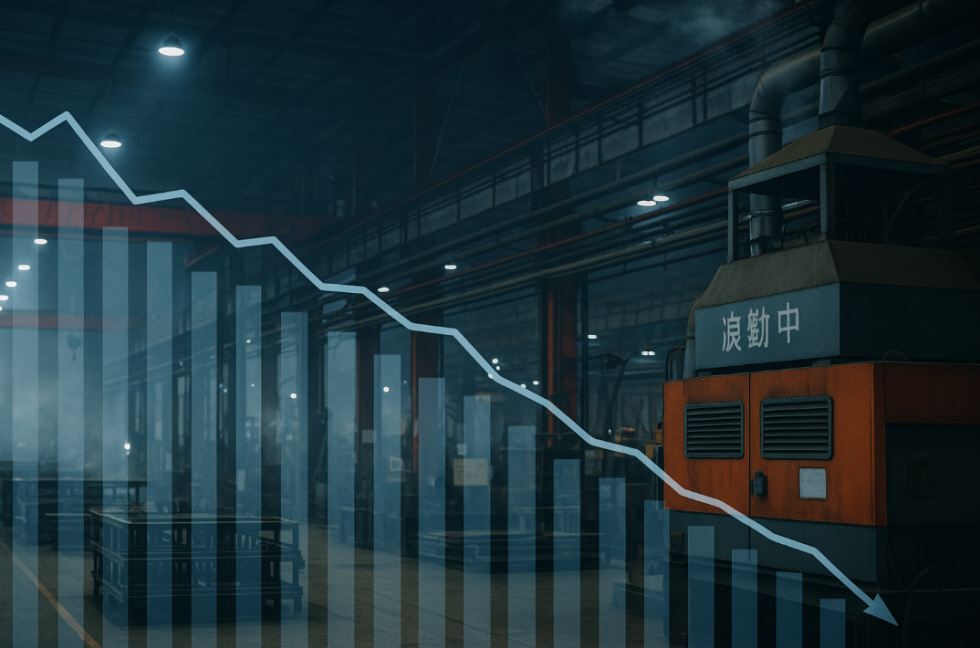
China’s manufacturing sector, long regarded as the backbone of the world’s industrial supply chain, has entered its weakest phase in nearly two years, sparking fresh waves of volatility across global markets. According to the latest Purchasing Managers’ Index (PMI) data, Chinese factory activity contracted for the third consecutive month, dropping to 48.6 in September — well below the neutral level of 50 that separates growth from decline.
The slowdown has raised new concerns among economists and investors, as it signals that both domestic demand and export performance are faltering in the world’s second-largest economy. The downturn is being felt well beyond China’s borders. Asian stock indices fell sharply following the release of the data, with the Nikkei and Hang Seng losing more than two percent in early trading.
In Europe, markets reacted with caution, while commodity prices — particularly copper and iron ore — slipped amid fears of weakening Chinese industrial output. The ripple effect underscores how dependent the global economy remains on China’s manufacturing engine, even as other regions attempt to diversify their supply chains. Economists point to several factors behind the deceleration.
Domestic consumption has slowed significantly as households face higher debt levels and stagnant wage growth, while the property sector remains under severe stress following the defaults of major developers. Export demand has also cooled, particularly from the United States and Europe, as global trade faces headwinds from tariffs, logistical disruptions, and tightening financial conditions. “China’s growth model is under structural pressure,” said Alicia García Herrero, Chief Economist for Asia-Pacific at Natixis.
“The transition from export-driven manufacturing to domestic consumption and innovation is proving slower and more difficult than anticipated.” In response, Beijing has announced a series of policy measures aimed at stabilizing growth, including tax incentives for small manufacturers, lower lending rates from state-owned banks, and renewed investment in high-tech industries.
The People’s Bank of China (PBOC) has also injected additional liquidity into financial markets to support business confidence. However, analysts say these steps may only offer temporary relief unless broader reforms are implemented to address structural weaknesses in productivity and capital efficiency. Global investors are watching closely as China’s slowdown could have far-reaching implications for world trade, commodity flows, and inflation trends.
A prolonged manufacturing contraction would likely weigh on emerging markets that rely heavily on exports to China, while advanced economies could face renewed supply chain disruptions. The International Monetary Fund has already revised its 2025 global growth forecast downward to 2.7%, citing weaker Chinese output as a key factor. Despite the challenges, some experts believe this deceleration could accelerate China’s pivot toward innovation and clean technology.
The government’s latest Five-Year Plan emphasizes sectors such as renewable energy, semiconductors, and electric vehicles as new engines of growth. “We are witnessing a strategic reshaping of China’s industrial landscape,” said Chen Long, Senior Analyst at Plenum Research. “The pain of slowdown may be the necessary step toward a more sustainable, innovation-led economy.”
For now, global markets remain in a state of cautious uncertainty. Investors are balancing optimism over potential stimulus measures against concerns about prolonged weakness in China’s industrial base. As volatility returns to equities and commodities, one thing is clear: the world’s economic pulse still beats in rhythm with China — and any disruption in that rhythm reverberates far beyond its borders.