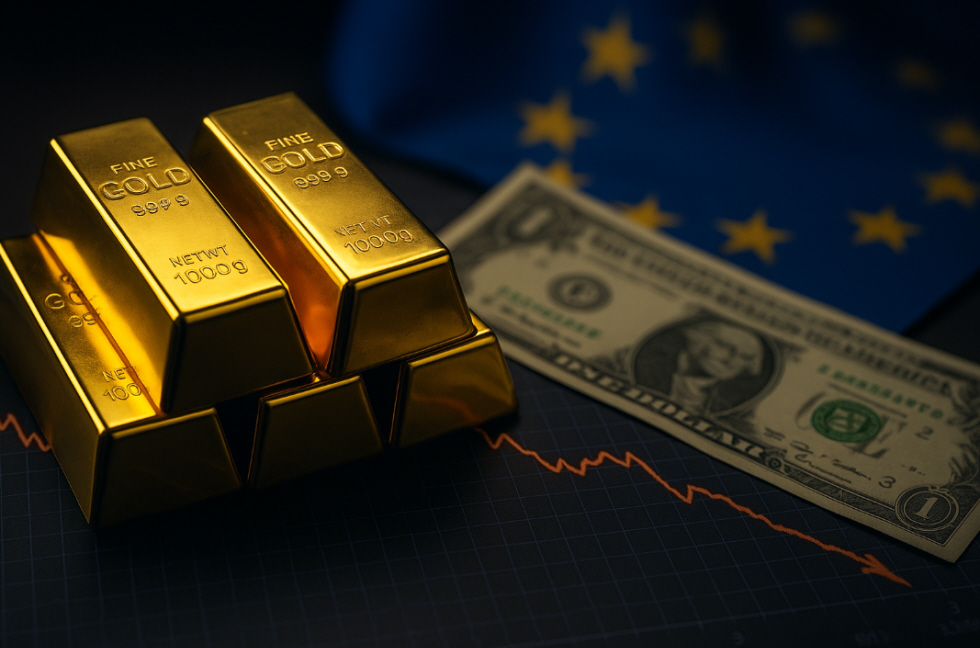
The U.S. dollar is facing renewed downward pressure in global currency markets as investors shift their positions toward gold and the euro, reflecting growing uncertainty about the future trajectory of American monetary policy. The U.S. Dollar Index (DXY), which measures the greenback against a basket of major currencies, has fallen to its lowest level in six months, slipping below 100.3 amid weaker-than-expected economic data and changing interest rate expectations.
The decline marks a reversal of the dollar’s two-year dominance and signals a subtle but important shift in global investor sentiment. Gold prices have surged past $2,400 per ounce, reaching their highest level on record as investors seek safe-haven assets to hedge against inflation and geopolitical instability. The euro, meanwhile, has appreciated nearly 4% against the dollar in recent weeks, supported by stronger growth in the Eurozone and expectations that the European Central Bank (ECB) will maintain a more stable policy stance than the U.S. Federal Reserve.
“The narrative is changing,” said Robert Mellor, senior currency strategist at JP Morgan. “The dollar is no longer the only refuge for global capital — diversification into gold, the euro, and even digital assets is now part of a broader risk management strategy.” The weakening of the dollar has multiple implications for the world economy. On one hand, it makes U.S. exports more competitive, offering potential relief to American manufacturers struggling with global demand slowdowns.
On the other hand, it increases the cost of imports, potentially complicating the Federal Reserve’s efforts to maintain price stability. The trend also affects emerging markets, many of which rely on dollar-denominated debt. A weaker dollar typically reduces repayment costs for those nations, offering some breathing room for economies under fiscal strain. Analysts point to several key drivers behind the dollar’s recent weakness.
The most significant factor has been the growing expectation that the Federal Reserve may begin cutting interest rates in early 2026 as inflation cools and economic growth moderates. In contrast, the ECB and the Bank of Japan have adopted relatively steady policy outlooks, giving their currencies a competitive edge. At the same time, rising geopolitical tensions and U.S. fiscal deficits have eroded confidence in the dollar’s long-term strength. The U.S. Treasury’s growing debt load, now exceeding $36 trillion, has prompted concerns among foreign investors about the sustainability of federal spending.
Gold’s resurgence highlights a broader narrative about global uncertainty. Beyond inflation, investors are responding to an increasingly complex geopolitical landscape — including conflicts in Eastern Europe and the South China Sea — that have heightened demand for tangible stores of value. Central banks, particularly in emerging economies, have also contributed to gold’s rally by expanding their reserves at record levels. The World Gold Council reports that central bank gold purchases reached 1,250 tons in the first half of 2025, the highest volume in more than a decade.
For Europe, the euro’s recovery underscores renewed confidence in the bloc’s economic resilience. Industrial production and service activity in key member states like Germany, France, and Spain have rebounded steadily, while inflation remains under control. The combination of stronger growth and balanced fiscal policy has positioned the euro as an attractive alternative for global reserves.
Despite these developments, currency strategists caution that volatility remains high. The next major shift in the dollar’s trajectory will depend heavily on the Federal Reserve’s decisions and global risk sentiment. “This is not the end of the dollar era,” said economist Lisa Chang from Morgan Stanley. “But it’s a reminder that the dollar’s dominance can no longer be taken for granted.”
As the greenback softens, gold glows brighter, and the euro gains momentum, global markets are entering a new phase of diversification — one in which the world’s financial power is slowly, but unmistakably, becoming more balanced.