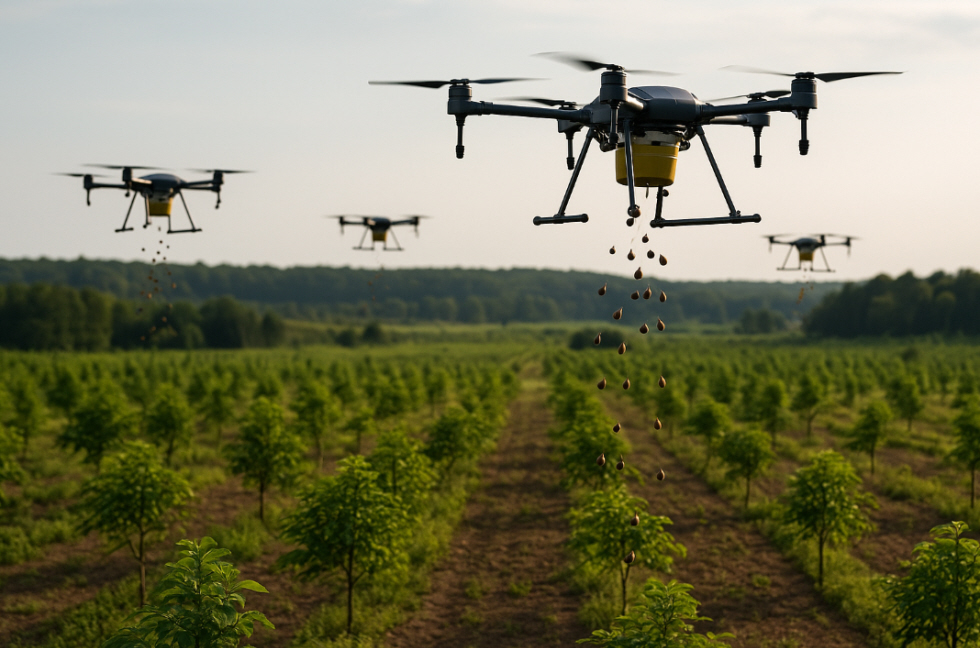
Across the world, autonomous drones are transforming the fight against deforestation, restoring millions of trees in areas where traditional planting methods are too slow or too costly. Armed with artificial intelligence, advanced navigation systems, and seed-dispersal technologies, these aerial reforestation fleets are making large-scale ecological recovery not just possible but efficient and measurable.
Environmental organizations, startups, and governments are now collaborating to replant forests faster than ever before — a critical step in mitigating the climate crisis. Companies like BioSeed Technologies, GreenSky Robotics, and TerraRegen are at the forefront of this environmental revolution. Their drones can cover up to 200 hectares per day, mapping terrain and soil composition in real time to determine the best planting strategy.
Once the data is processed, the drones drop biodegradable seed pods filled with nutrients and moisture-retaining gel to maximize germination success. With some fleets capable of planting over 100,000 trees a day, these systems are achieving results that previously took years. “The speed and precision of these reforestation drones have changed the game,” said Dr. Miguel Santos, an environmental engineer at the Global Forest Initiative.
“We’re no longer just talking about planting trees — we’re rebuilding ecosystems, restoring biodiversity, and capturing carbon at scales that were unimaginable a decade ago.” Many of these projects are also integrating satellite data and machine learning to track seedling survival over time. AI-driven analytics help identify which species thrive under certain microclimates, allowing future missions to fine-tune planting strategies for better long-term success. In the Amazon rainforest, for example, drones have been used to restore buffer zones near river systems, protecting habitats and preventing soil erosion.
In Southeast Asia, similar technologies are being applied to rehabilitate mangrove forests, which are among the most effective natural carbon sinks on Earth. Beyond environmental restoration, these drone initiatives are creating new economic opportunities. In regions of Africa and Latin America, reforestation startups are partnering with local communities, providing training and employment in drone operation, maintenance, and environmental monitoring.
This approach not only helps restore the land but also empowers people economically, turning ecological recovery into a sustainable livelihood. Despite their potential, drone reforestation projects still face challenges such as weather disruptions, limited battery life, and the complexity of scaling operations across diverse terrains. However, rapid technological progress — including solar-powered charging stations and autonomous fleet coordination — is making these systems increasingly reliable and self-sufficient.
Experts estimate that if current expansion rates continue, autonomous reforestation could contribute up to 10 percent of global carbon capture targets by 2035. With governments and environmental agencies now investing heavily in this technology, the vision of restoring the planet’s lost forests is no longer a distant dream but a rapidly growing reality. In an era where the world seeks both speed and sustainability, drones are proving to be the wings of environmental renewal.