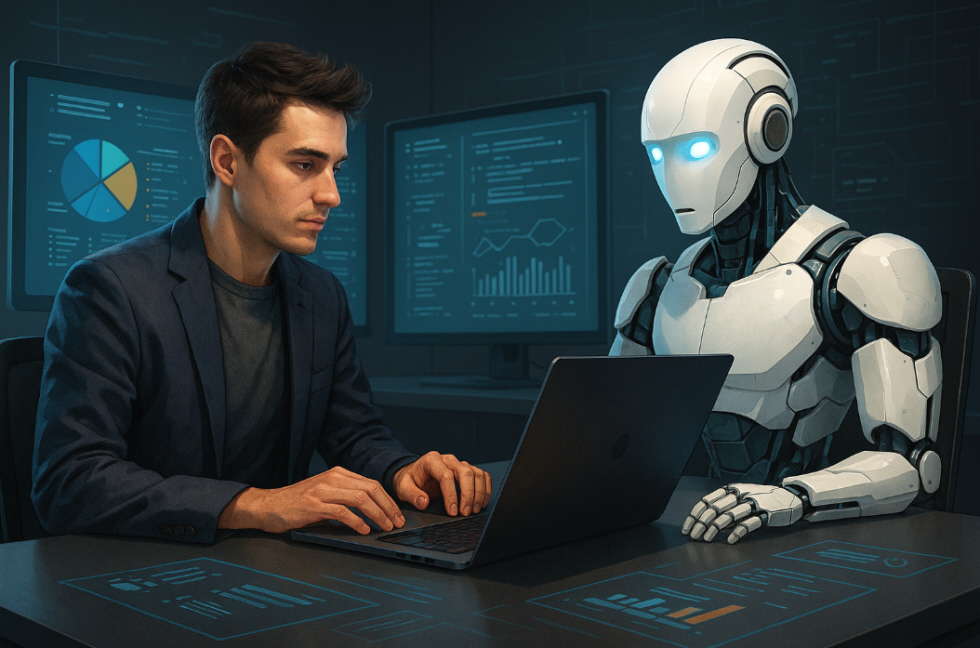
A new wave of tech startups is redefining the meaning of entrepreneurship by introducing artificial intelligence not just as a tool, but as a co-founder. From early-stage ideation to strategic planning, AI-driven systems are now assuming roles traditionally held by human executives — analyzing markets, optimizing business models, and even negotiating contracts. This emerging trend, dubbed “AI co-founding,” is rapidly reshaping how innovation is conceived and executed across the global startup ecosystem. In cities like San Francisco, London, and Singapore, founders are beginning to integrate large language models and autonomous agents directly into their core operations.
These systems act as tireless partners — capable of generating pitch decks, predicting investor behavior, and designing marketing campaigns within minutes. By automating repetitive and time-consuming tasks, AI co-founders enable human entrepreneurs to focus on creativity, relationship-building, and strategic growth. “It’s like having a second brain that never sleeps,” said Mika Tan, CEO of NovaSeed, a Singapore-based startup that recently raised $4.2 million with an AI-driven management platform.
The appeal of AI co-founders lies in speed and scalability. In traditional startups, product development can take months of trial and error; with machine learning integration, prototypes can be tested, refined, and launched in a fraction of that time. Startups are using generative models to write code, design user interfaces, and simulate user feedback, dramatically reducing operational costs.
This acceleration has attracted venture capitalists eager to fund teams that combine human insight with algorithmic precision. Yet this innovation comes with complex implications. Legal experts are now debating how to assign intellectual property rights and decision-making authority when an AI is technically part of the founding team. Some investors require “AI disclosure clauses” in contracts to clarify accountability for errors or unethical outcomes. Others argue that, while AI can generate valuable insights, ultimate control should remain firmly in human hands. Beyond the legal challenges, there are cultural ones.
The idea of a non-human partner making key business decisions raises ethical questions about trust, transparency, and creative ownership. Critics warn that relying too heavily on automated systems could create uniform thinking and suppress the unpredictability that often sparks breakthrough ideas. In response, some accelerators are experimenting with hybrid mentorship models, pairing AI advisors with experienced entrepreneurs to preserve a balance between innovation and intuition.
Despite the concerns, momentum continues to build. Analysts predict that within the next five years, more than 30 percent of startups will incorporate AI systems as operational co-founders, using them for financial modeling, talent recruitment, and real-time analytics. The most successful teams will likely be those that recognize AI not as a replacement for human leadership, but as an extension of it — a collaborator that amplifies creativity and efficiency in equal measure.
As the boundaries between human and machine intelligence continue to blur, the startup world stands at the edge of a new paradigm. In this evolving landscape, success may no longer depend solely on who your human partners are, but also on how well you design — and trust — your artificial ones.