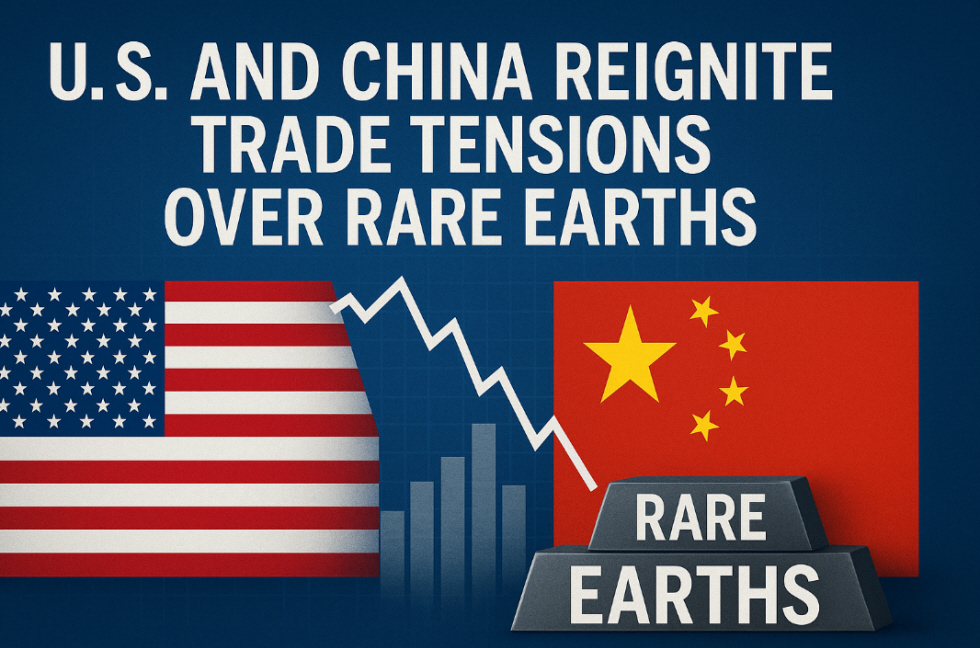
It feels like déjà vu: Donald Trump threatens China with new punitive tariffs, Beijing strikes back with export bans, and suddenly a trade war is back on the table. But this time, the confrontation goes far beyond cheap consumer goods or low-cost automobiles. The new battlefield lies in the realm of rare earths—critical metals without which no smartphone, electric vehicle, or modern defense system can function.
Unlike the tariff wars of 2018 and 2019, this new phase has a much deeper and more strategic dimension. Rare earth elements, such as neodymium, dysprosium, and terbium, are indispensable for the production of semiconductors, wind turbines, advanced batteries, and precision-guided weapons. China currently controls more than 70 percent of global production and nearly 90 percent of refining capacity, giving Beijing an undeniable advantage in a market that underpins the world’s technological infrastructure. For the United States, the concern is clear: dependence on China for such critical materials has become a national security risk.
The Trump administration’s renewed threats to impose tariffs are being presented as a defense of American strategic autonomy. But economists warn that retaliatory measures by Beijing could have an immediate global impact, driving up prices, disrupting supply chains, and creating instability in key sectors such as electric mobility and renewable energy. The geopolitical implications extend far beyond the realm of trade. A prolonged confrontation could accelerate the formation of parallel supply networks, with Western nations seeking alternative sources in Africa, Australia, and Latin America, while China strengthens its technological partnerships across Asia and the Global South.
In this emerging world order, control over resources like lithium, cobalt, and rare earths could become as decisive as control over oil was in the twentieth century. Financial markets have already reacted with volatility. Mining stocks surged in anticipation of supply disruptions, while tech manufacturers signaled concern over possible shortages of essential components.
Industry leaders warn that rebuilding domestic refining capabilities in the West will take years and require significant environmental compromises, as rare earth processing generates toxic waste that few countries are willing to handle. Analysts agree that this dispute is not simply about trade policy—it reflects the new structure of global power. The rivalry between Washington and Beijing has evolved into a broader competition for technological leadership and control of strategic resources.
For companies and investors, this means entering an era of uncertainty where economic decisions will increasingly be shaped by geopolitical calculations rather than pure market logic. As tensions rise, one thing becomes clear: the trade war of the future will not be fought with tariffs on steel or textiles, but with access to the minerals that power the modern world. In that sense, today’s headlines are more than just a repetition of the past—they are a warning that the next global economic confrontation has already begun.